
CGR 2026


Introduction
Rethinking value for a circular economy
Each day, billions of euros’ worth of materials disappear. These losses often go unnoticed, but their consequences are significant. Food spoils along supply chains, raising household costs. Electronics are discarded long before their potential is exhausted. Homes are underutilised despite widespread housing shortages. Clothing is often worn briefly and discarded; inventories accumulate unused in warehouses. Beyond the immediate economic waste, these losses carry hidden environmental and social costs such as pollution, resource depletion, and unequal access to essential goods that conventional measurements of value rarely capture, while also undermining the productivity and resilience of the resources and systems involved. These are symptoms of a deeper structural challenge: a linear economic model that undervalues natural resources, underutilises produced assets, and enables premature disposal.
The environmental impacts of this model are significant. Resource use has tripled since 1970, and more than half of global greenhouse gas emissions, most biodiversity loss, and water stress stem from the extraction and processing of materials. [1] Human-made materials now outweigh all living biomass. [2] Yet this surge in material consumption is no longer delivering an increasing return. Global resource productivity—the economic output generated per unit of material used—has effectively stalled over the past decade. [3] Businesses and economies are consuming more material inputs without real efficiency gains. With this in mind, the circular economy is not only a key approach to help reduce ecological pressures but also represents a significant economic opportunity. The Circularity Gap Report (CGR®) 2026 shifts the lens from environmental indicators to an economic perspective by asking a fundamental question: What is the extent of avoidable value lost through linear and inefficient economic practices?
Answering that question requires confronting a deceptively simple premise: What does value mean? Value is not only a price tag. It is a multidimensional concept that has preoccupied economists and philosophers for centuries, capturing tensions between what something costs and what it is worth. [4] In practice, value is socially constructed, context-dependent, and often contested. [5] Prices are meant to reflect value in monetary terms, yet they rarely do. Market imperfections, externalities, incomplete information, and unequal power relations distort price signals. Critical natural capital like forests, soils, and freshwater systems underpin life, and the functioning of the economy, yet its depletion is not reflected in market valuations. [6] Likewise, a kilogram of critical raw materials in a medical device embodies far greater societal value than the same kilogram used in short-lived electronics, yet this difference is only partially visible in market prices.
This disconnect stems from the limits of the linear economic paradigm. Traditional economic theories typically focus on market exchange and consumption but overlook biophysical limits and long-term well-being. These also often overlook the usefulness of materials, their contribution to well-being, and the impacts generated across the life cycle. A circular economy requires a broader and more practical understanding of value, one grounded in how materials and products accumulate and lose value across their entire life cycle. A useful way to visualise this is the idea of a ‘value hill’ (Figure one). In the early, upstream stages of production, value is created as a myriad of raw materials are extracted, refined, and processed. These materials—metals, minerals, plastics, glass—are transformed into specialised components through energy- and skill-intensive processes. Midstream, these components are assembled into complex final products. By the time a product reaches the final user, it embodies not just materials and energy but also design, labour, knowledge, and technology.
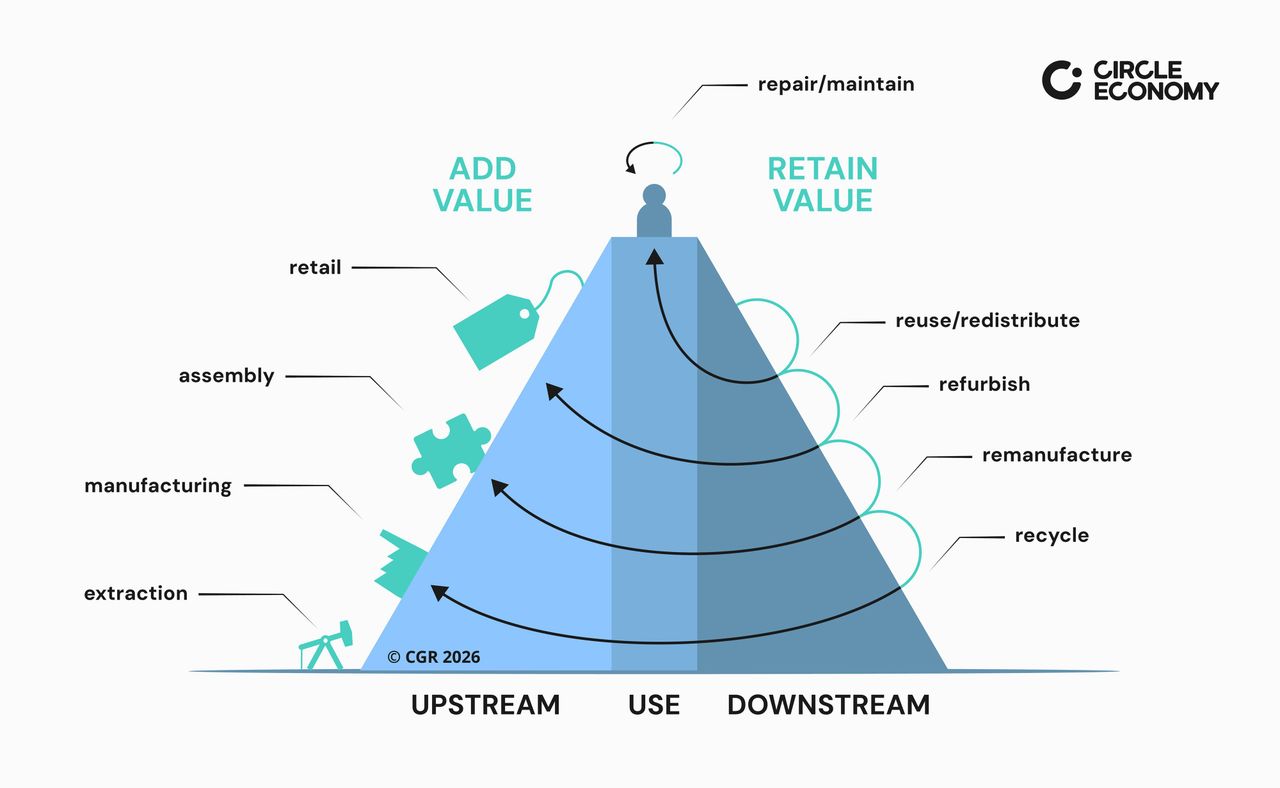
Figure one: Visual depiction of the value hill, showing how value is categorised across the product lifecycle: pre-use (upstream), in-use, and post-use (downstream) phases of materials. Source: Circle Economy
Across these stages—extraction, processing, manufacturing, use, and end-of-life—value is both created and destroyed. Inefficiencies in supply chains can lead to material losses; premature disposal shortens the useful life of well-functioning products; and the environmental and social costs of extraction, pollution, and unsafe working conditions remain largely unaccounted for in market prices. These hidden losses and costs accumulate along the value hill, leaving society to bear the consequences. Circular approaches aim to help reshape this trajectory by extending product lifetimes, improving reuse and repair, and recovering the value of materials at the end of life, which helps ensure that value loss is minimised and the value created is not squandered.
Ultimately, rethinking value is fundamental to rethinking the economy itself. At its core, value signals three things. First, it reflects usefulness: how much a material or product contributes to something people need. Second, scarcity: how limited or difficult it is to replace a resource or product. Third, complexity: the skill, technology, resources and energy embedded in its production. [7] But value also signals purpose: how well essential systems such as nutrition, housing, and mobility deliver well-being equitably, efficiently, and sustainably. Seen this way, value links resources, economies, and societies. A circular economy requires value frameworks that recognise the contribution of resources to human flourishing, account for ecological limits, and help address the broader impacts of resource management. Only with a richer, more holistic understanding of value can the economic and social potential of circularity be unlocked, and the global Value Gap closed.
From material gaps to value gains
The last edition of the global CGR® reported a Circularity Metric of 6.9%, meaning that 93.1% of materials entering the economy come from virgin sources. [8] While the Circularity Metric quantifies the share of materials entering the economy as secondary materials, it also highlights the economic implications of linearity. Low circularity not only signals large ecological impacts but also represents vast economic losses, both because nature is critical for the economy and its destruction poses systemic economic risks, and because linear practices can lead to wastefulness and overuse.
Building on this insight, the Value Gap quantifies the economic dimension of these material losses. It focuses on inefficient material use, including waste and losses caused by suboptimal technological processes, lack of infrastructure, or improper treatment throughout the supply chain. It also accounts for premature value loss driven by behavioural, regulatory, or economic failures that prevent long-lived products and assets from being fully utilised. Closing the Value Gap, therefore, means both avoiding value loss and preserving existing value, showing that circularity can translate directly into tangible economic gains.
Each inefficiency in resource management, discarded product, and underutilised asset, along with their associated environmental and social costs, represents not just a loss but also a missed opportunity: to avoid value loss and preserve existing value. Well-designed circular economy strategies that promote resource efficiency and sufficiency at the system level can translate into tangible economic, social, and environmental gains. They can also be a core, practical way of delivering human well-being for all within the ecological limits of the planet.
By connecting the material realities of the Circularity Gap with the economic insights of the Value Gap, this report reframes circularity as both an environmental imperative and a strategic opportunity, guiding businesses, financiers, and policymakers to focus on interventions with the highest potential for long-term socioeconomic and environmental value creation.
The Circularity Gap Report is an initiative of Circle Economy, an impact organisation dedicated to accelerating the transition to the circular economy.
© 2008 - Present | RSIN 850278983