
CGR 2026


Understanding the Value Gap
Interpreting value loss: Pathways, mechanisms, and stages
The initial estimate of €25.4 trillion (± €4.7 trillion) in total value loss can be interpreted through three complementary lenses: value loss pathways, value loss mechanisms, and value chain stages (Figure two). First, value loss can be viewed as the aggregate of five pathways that structure losses along physical and monetary flows, as discussed in detail in The Value Gap. Second, it can be understood through the mechanisms by which it occurs. That is, the underlying processes that drive inefficiencies and value destruction. Third, value loss can be examined from a value-chain stage perspective to show where, along the lifecycle of materials and products, value losses predominantly arise.
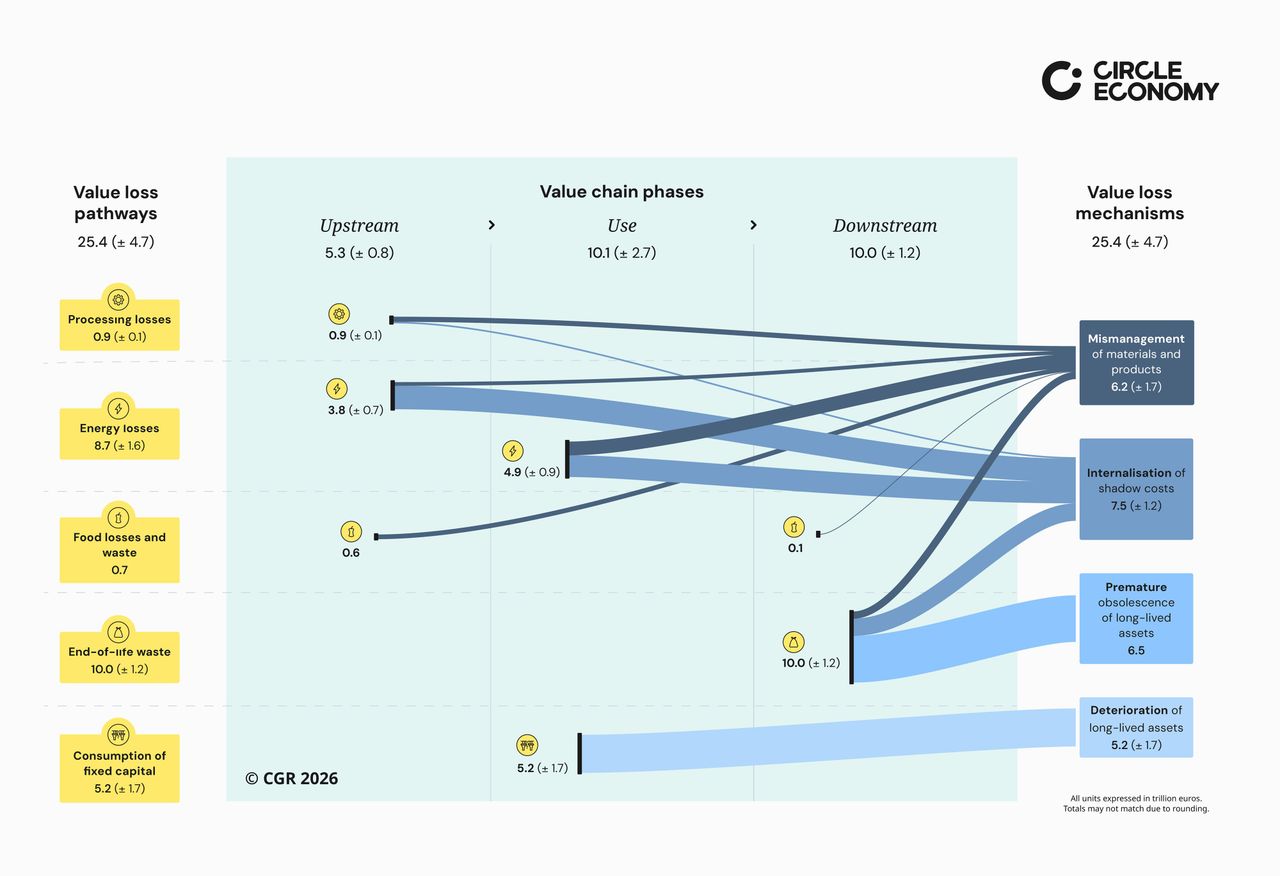
Figure two: Overview of value loss pathways and the mechanisms driving them across the value chain. Source: Circle Economy.
Why value loss occurs: From pathways to mechanisms
While pathways describe how value is lost in terms of physical and monetary flows, mechanisms explain why these losses occur. Pathways capture the manifestations of value loss—for example, through processing losses, food waste, energy losses, end-of-life waste, or asset retirement—whereas mechanisms focus on the underlying processes that generate these outcomes. These mechanisms reflect a complex interplay of physical, technological, behavioural, and regulatory factors and apply to materials embedded in both short-lived flows and long-lived stocks. In monetary terms, physical losses translate into foregone residual material or product value, collection and treatment costs, depreciation, and unpriced environmental and social costs.
Four main mechanisms explain how inefficient material use translates into value loss:
Viewed through this lens, mismanagement of products and materials accounts for €6.2 trillion (± €1.7 trillion), or about 24% of total value loss. Internalised shadow costs contribute €7.5 trillion (± €1.2 trillion), representing about 30% of total value losses. Premature obsolescence of long-lived assets accounts for €6.5 trillion (about 26% of total value loss), while deterioration of long-lived assets—equivalent to consumption of fixed capital—amounts to €5.2 trillion (± €1.7 trillion), about 20% of total value loss.
Insights for future iterations of the Circularity Gap Report: The Value Gap
As this is the first edition of the global CGR: The Value Gap, the approach presented here should be viewed as a foundation for ongoing refinement and improvement. The Value Gap represents a first attempt to engage with the inherently complex question of how value is created, lost, and measured within today’s economy. While it offers only a partial picture, it helps illuminate where linear practices erode value and where circular strategies have the potential to retain it more effectively. As such, it provides a foundation for further research into how value is defined and measured in ways that better reflect how circular resource use can contribute to increased productivity, resilience and long-term well-being.
Measuring the Value Gap will likely evolve as new data, tools, and research become available. This section highlights key insights and areas where further work could strengthen future iterations of the metric: improving its accuracy, expanding its scope, and enhancing its usefulness for policymakers, businesses, and a broader range of stakeholders across sectors.
Closing the Value Gap beyond resource efficiency
Inefficient material use in the global economy is not only a question of wasted materials, but also of how materials and value are distributed. The circular economy is often framed exclusively as a technical challenge: improving resource efficiency, maximising recycling, reducing waste, and strengthening competitiveness. [37] While these goals are important, they are not sufficient. [38] Closing the Value Gap is not only about how efficiently resources are used and circulated, but also about what they are used for and whether they contribute to advancing societal well-being within planetary boundaries.
Value creation is not purely quantitative. Producing and consuming more goods and services can increase economic output while delivering limited social benefit or even reinforcing inequality, overconsumption, and environmental harm. In this sense, value can be lost not only through wasted materials, but through misdirected resource use: when scarce resources are channelled into low-value or excessive consumption while essential needs elsewhere remain unmet. [39]
A circular economy that focuses solely on keeping materials in use risks reproducing these imbalances. To realise its full potential, circularity should also be guided by principles of sufficiency: reorienting from a primary focus on (re)cycling toward material demand reduction, lifetime extension, and higher value retention. [40] This requires shifting attention from volume and throughput towards possible outcomes: improved well-being, reduced inequality, and resilient socio-ecological systems. [41]
Ultimately, a value-centred circular economy depends on asking the right questions: How do we measure value? What does the economy provide? For whom? And at what cost to the planet and society?
Viewed in this way, the Value Gap shifts the focus from how much the economy produces to how well it converts economic activity into lasting value. A high Value Gap indicates that a large share of economic effort is lost rather than contributing to sustained well-being or long-term prosperity. Reducing the Value Gap, therefore, highlights a core opportunity for circularity: redesigning products, businesses and systems so that more of the value created is retained, more evenly shared, and carried forward over time.
The Circularity Gap Report is an initiative of Circle Economy, an impact organisation dedicated to accelerating the transition to the circular economy.
© 2008 - Present | RSIN 850278983